


Problem Statement
Mercury is a 10 year old legacy application which is used for creating and managing meetings & conferences in a multinational organisation. The primary users of this application are coordinators and corporate access users who work with portfolio managers and research analysts. They are constantly scheduling new meetings and managing the same for them. Needless to say that these portfolio managers have a very busy schedule, they rarely create meetings for themselves. Hence, coordinators /corp access users create and manage meetings on their behalf. Creating and managing multiple meetings for an upcoming conference in this application is a tedious task as it is time consuming and has many usability issues.
Objective
* To be able to decommission legacy successfully and incorporate all features of Corp Access teams
* Enable Research Analysts and Portfolio Managers to use Mercury themselves for creating and managing meetings
* Satisfying the needs of Corp access users
Situation Analysis
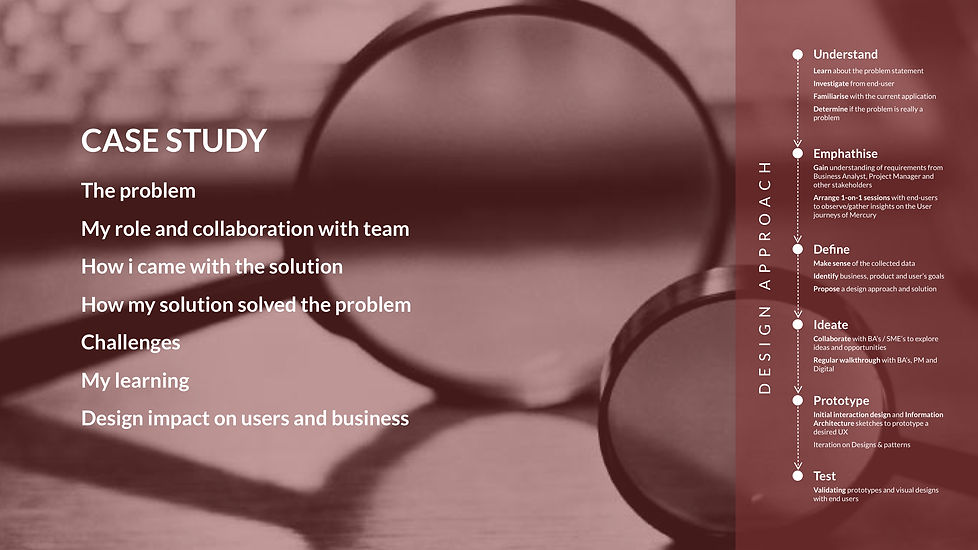
Task flow of existing application


Identifying Users And Stakeholders and Their Interviews
Gathering information from the stakeholder and user to understand their goals and expectations

Defining different goals
Different goals were defined to find a sweet spot.

User journey map
Gathering information from the stakeholder and user to understand their goals and expectations

Proposed task flow
The below task flow was proposed

Initial thoughts/concepts
Example of some thoughts to come up with a solution.
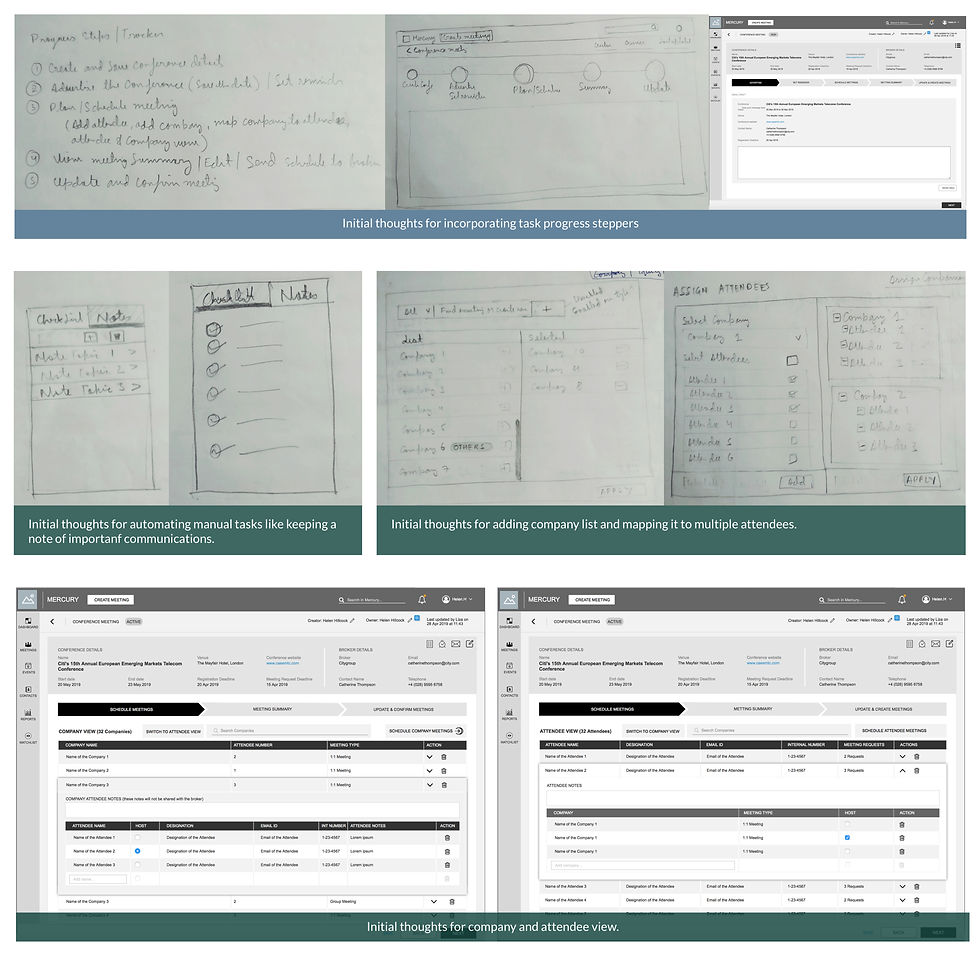
Wireframe, Prototype & Iterative design
The below concepts were explored to come up with a solution.

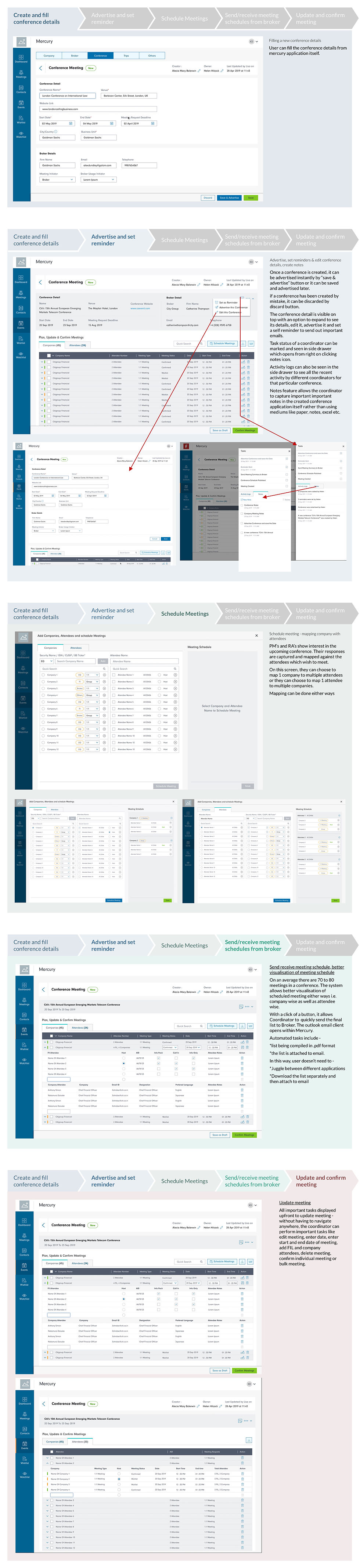
Visual Design
The below task flow was proposed

Limited time
It was initiated as an urgent project and overall time for UX work was aggresive.
Skipping of steps in design process
The expectation of the stakeholder was to get the design mocks ready quickly on the basic of refrence pdfs and a brief walkthough. He had no clue about different design steps to approch the solution. However it some time to get him familiar with the minimum required design steps to solve the problem.
Attempts to change design while development.
Though the entire team (stakeholders from business and technology, Developers) were involved throughout design process, but while executing it in development, there were several attempts to change the design to save the development time.

Design impact on Users
* User doesn’t need to juggle between different application
* Reduced the task completion time with simple task flow and less number of clicks.
* Reduced manual task of maintaining notes in physical notebook for all the communication with broker, PMs, analysts through note feature.
* Introduced short cut for lengthy tasks through multiple company and attendees mapping either ways.
* All important tasks displayed upfront to update meeting without having to navigate anywhere. (the coordinator can perform important tasks like edit meeting, enter date, enter start and end date of meeting, add FIL and company attendees, delete meeting, confirm individual
meeting or bulk meeting)
*The usage by PM’s and Analysts using the new application themselves
* Easy to mail conference schedule for single as well as multiple attendees
Design impact on Business
* Decommission legacy and incorporate all features of Corp Access teams in new application
* Simplified conference management needs across different regions
* Easy to track efforts of coordinators through activity log feature
* Easy to mail conference schedule for single as well as multiple attendees

Efficient way for multiple parent and child mapping.
Collaboration with the team and Alignment of team throughout design process.
Early Feedback is the King
Design Iteration based on feedbacks
Being Rationale